


 52 / 172

Abstracts of the 22
nd
National Congress of Digestive Diseases / Digestive and Liver Disease 48S2 (2016) e67–e231
e113
levels according to age only in SAMP mice. Pearson’s parametric
analysis showed a moderate negative correlation between histologic
scores and VD levels (r2=0.493, p=0.096), and a strong, significant
negative correlation between stereomicroscopy scores and VD levels
(r2=0.742, p=0.037).
Conclusions:
In our preliminary study, low VD levels were detected
in the early phases, as well as the chronic stage of ileitis in SAMP
mice. VD levels were significantly lower in SAMP than in control
mice independent of environmental factors or diet type. A negative
correlation was found between VD levels and disease severity, and
this was particularly true for stereomicroscopic assessment of ileitis.
Low VD levels may be a contributing factor to the development of
ileitis in thismodel. These findings provide a rationale formechanistic
studies investigating the effects of dietary VD supplementation and
depletion in SAMP mice with CD-like ileitis.
OC.11.6
LOCALIZATION OF EBV IN COLONIC MUCOSAL CELLS OF IBD
PATIENTS AND CORRELATION WITH DISEASE ACTIVITY INDEXES
Ciccocioppo R.*
1
, Racca F.
1
, Scudeller L.
2
, Formagnana P.
1
, Piralla A.
3
,
Pozzi L.
1
, Betti E.
1
, Cangemi G.C.
1
, Vanoli A.
4
, Riboni R.
5
, Baldanti F.
6
,
Corazza G.R.
1
1
1Clinica Medica I; Fondazione IRCCS Policlinico San Matteo,
Università di Pavia; Italia., Pavia, Italy,
2
2Servizio di Biometria ed
Epidemiologia Clinica; Fondazione IRCCS Policlinico San Matteo,
Università degli Studi di Pavia; Italia., Pavia, Italy,
3
3Virologia
Molecolare; Fondazione IRCCS Policlinico San Matteo, Università
degli Studi di Pavia; Italia., Pavia, Italy,
4
4Dipartimento Medicina
Diagnostica; Fondazione IRCCS Policlinico San Matteo, Università degli
Studi di Pavia; Italia., Pavia, Italy,
5
5Dipartimento di Scienze Cliniche,
Chirurgiche, Diagnostiche e Pediatriche; Fondazione IRCCS Policlinico
San Matteo, Università degli Studi di Pavia; Italia., Pavia, Italy,
6
3Virologia Molecolare, 5Dipartimento di Scienze Cliniche, Chirurgiche,
Diagnostiche e Pediatriche; Fondazione IRCCS Policlinico San Matteo,
Università degli Studi di Pavia; Italia., Pavia, Italy
Background and aim:
Epstein-Barr virus (EBV) can establish
latency in target cells and reactivate in case of reduced host
immunity, as in inflammatory bowel disease (IBD) patients under
immunosuppressive therapy, giving rise to systemic and end-organ
disease. We previously demonstrated the presence of high EBV DNA
load in the intestinal mucosa of refractory IBD patients.
To evaluate the presence of EBV infection in epithelial and immune
cells of colonic mucosa of IBD patients, both responders (IBD-R) and
non-responders (IBD-NR) to standard therapies, in order to establish
its localization, DNA load and correlation with disease activity
indexes.
Material and methods:
We enrolled 30 IBD-R (19 M, median age
38.5y), 20 IBD-NR (20 M, 49.5y) and 25 healthy controls (HC; 13 M,
49y). Clinical (CDAI: Crohn disease activity index; SCCAI: simple
colitis clinical activity index) and endoscopic (CDEIS: Crohn disease
endoscopic index of severity; UCEIS: ulcerative colitis endoscopic
index of severity) scores were calculated. All subjects underwent
lower endoscopy with biopsies for cellular separation by enzymatic
digestion. The viral load in enterocytes, intraepithelial lymphocytes
(IELs) and lamina propria mononuclear cells (LPMCs) was assessed
by quantitative RT-PCR, and expressed as copies/10
5
cells. The
appropriate statistical tests were applied.
Results:
EBV DNA was detected in LPMCs of all IBD-NR, 20 IBD-R and
7 HC (p=0.03), in IELs of 18 IBD-NR, 16 IBD-R and 9 HC (p=0.01), and
in enterocytes of 17 IBD-NR, 7 IBD-R and 0 HC (p=0.02). A higher viral
load was found in all the cell populations of IBD-NR (median 5.605
in LPMCs, 3.876 in IELs, 2.974 in enterocytes) as compared to IBD-R
(27,0,0 respectively; p<0.001), and to HC (0 in all cell populations,
p<0.001). No difference was found between IBD-R and HC. Higher
levels of viral DNA were found in all cell populations from inflamed
versus non-inflamed mucosa in both the IBD groups (p<0.001) and
in the inflamed mucosa of IBD-NR versus IBD-R (p<0.001). A positive
correlation was found between viral load of inflamed mucosa of
IBD-NR and SCCAI, CDAI and CDEIS.
Conclusions:
Our novel result is the presence of EBV DNA in the
epithelial cells of IBD patients, other than in all the immune cells
with higher levels in those harvested from inflamed versus non-
inflamed mucosa and a positive correlation with both clinical and
endoscopic indexes of activity.These data suggest a direct role of
EBV in the development of mucosal lesions through an active viral
replication in the epithelial cells.
OC.11.7
MOTIVATIONAL INTERVIEWING IN OUTPATIENTS COUNSELLING:
DATA FROM A LARGE CASE-CONTROL STUDY IN INFLAMMATORY
BOWEL DISEASE PATIENTS
Mocciaro F.*
1
, Di Mitri R.
1
, Bossa F.
2
, Scimeca D.
2
, Russo G.
1
,
Pecoraro G.M.
1
, Biscaglia G.
2
, Martino G.
2
1
Gastroenterology and Endoscopy Unit, ARNAS Civico-Di Cristina-
Benfratelli Hospital, Palermo, Italy,
2
Division of Gastroenterology, Casa
Sollievo della Sofferenza Hospital, IRCCS., San Giovanni Rotondo (FG),
Italy
Background and aim:
Motivational interviewing (MI) is a patient-
centered counselling also proven useful in inflammatory bowel
disease patients. Some skills are at the base of a successful MI:
the ability to ask open ended questions, the ability to provide
affirmations, the capacity for reflective listening, and the ability
to periodically provide summary statements to the patients. We
report data from a case-control study (1:1 ratio) on MI applied to
IBD patients.
Material and methods:
Between June 2014 and March 2015 we
collected data from 2 IBD referral centers both with knowledge on
MI skills but only one of these (case group) currently applied this
technique during the visits. At the end of visit all patients filled out
an anonymous questionnaire.
Results:
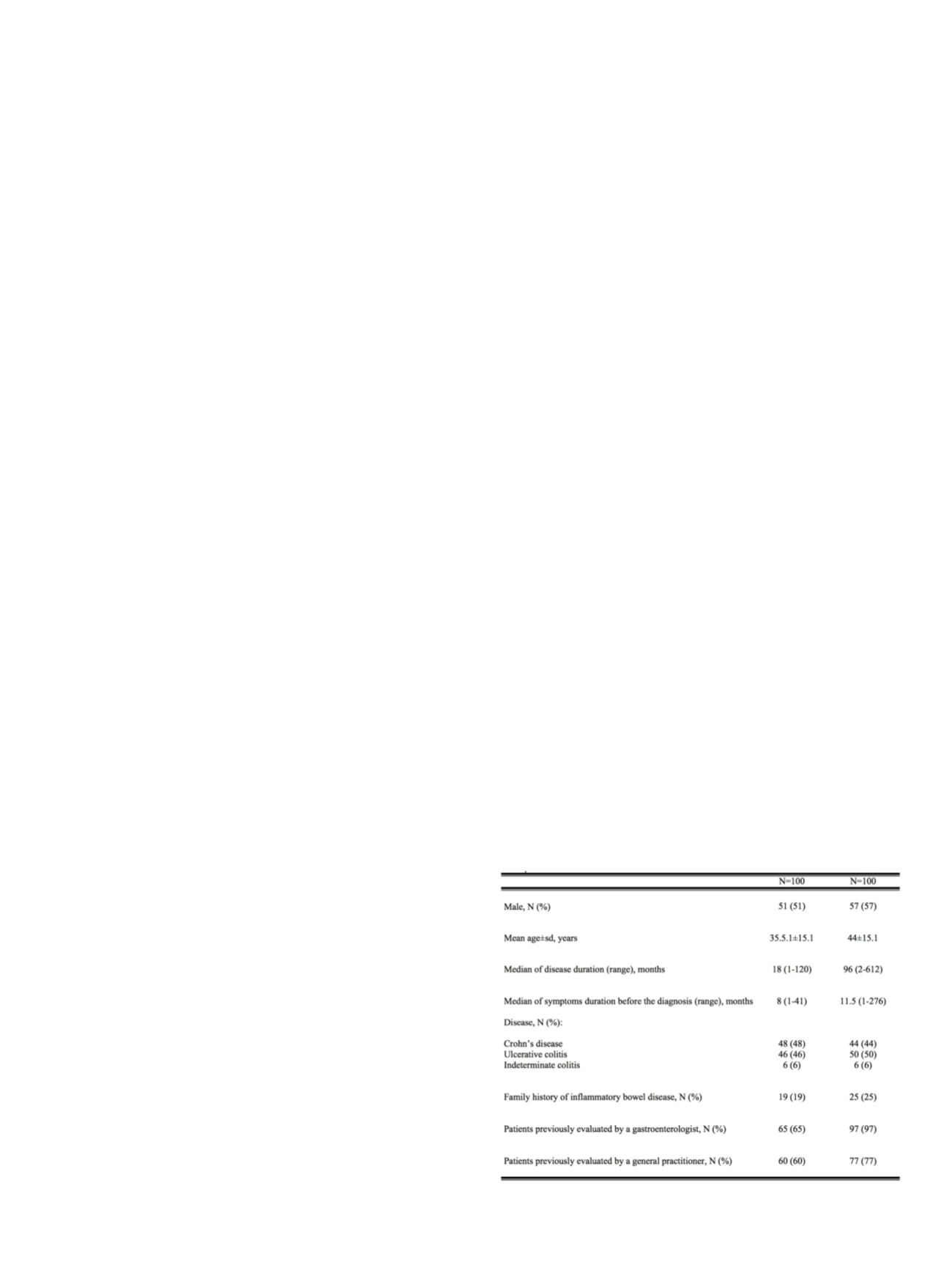
200 patients (108 males [54%]) with a mean age of 40.3±15.5
years were evaluated. Ninety-two patients were affected by Crohn’s
disease (46%), 96 by ulcerative colitis (48%), and 12 by indeterminate
colitis (6%). In table 1 are summarized all patients’ characteristics. At
final analysis 162 patients (81%) were previously evaluated by a
gastroenterologist with an acceptable satisfaction rate (68%) which
significantly decreased in those at the first outpatient visit (54%,
p<0.001).