


 42 / 172

Abstracts of the 22
nd
National Congress of Digestive Diseases / Digestive and Liver Disease 48S2 (2016) e67–e231
e103
Material and methods:
A quality improvement (QI) project was
therefore organized in 5 regions of central Italy (Campania, Lazio,
Marche, Toscana and Umbria) by using the Plan-Do-Study-Act
(PDSA) method with the aim to i) identify ii) measure the problem
iii) design a range of interventions designed to overcome the
various barriers and suitable to be implemented at local centre and
iv) verify whether the interventions worked. Two audit cycles with
web data collection were planned with a variable implementation
period in between. The regional SIED Coordinators invited centres to
provide data of at least 50 routine and screening colonoscopies and
monitored the project with an independent timing among regions.
Results:
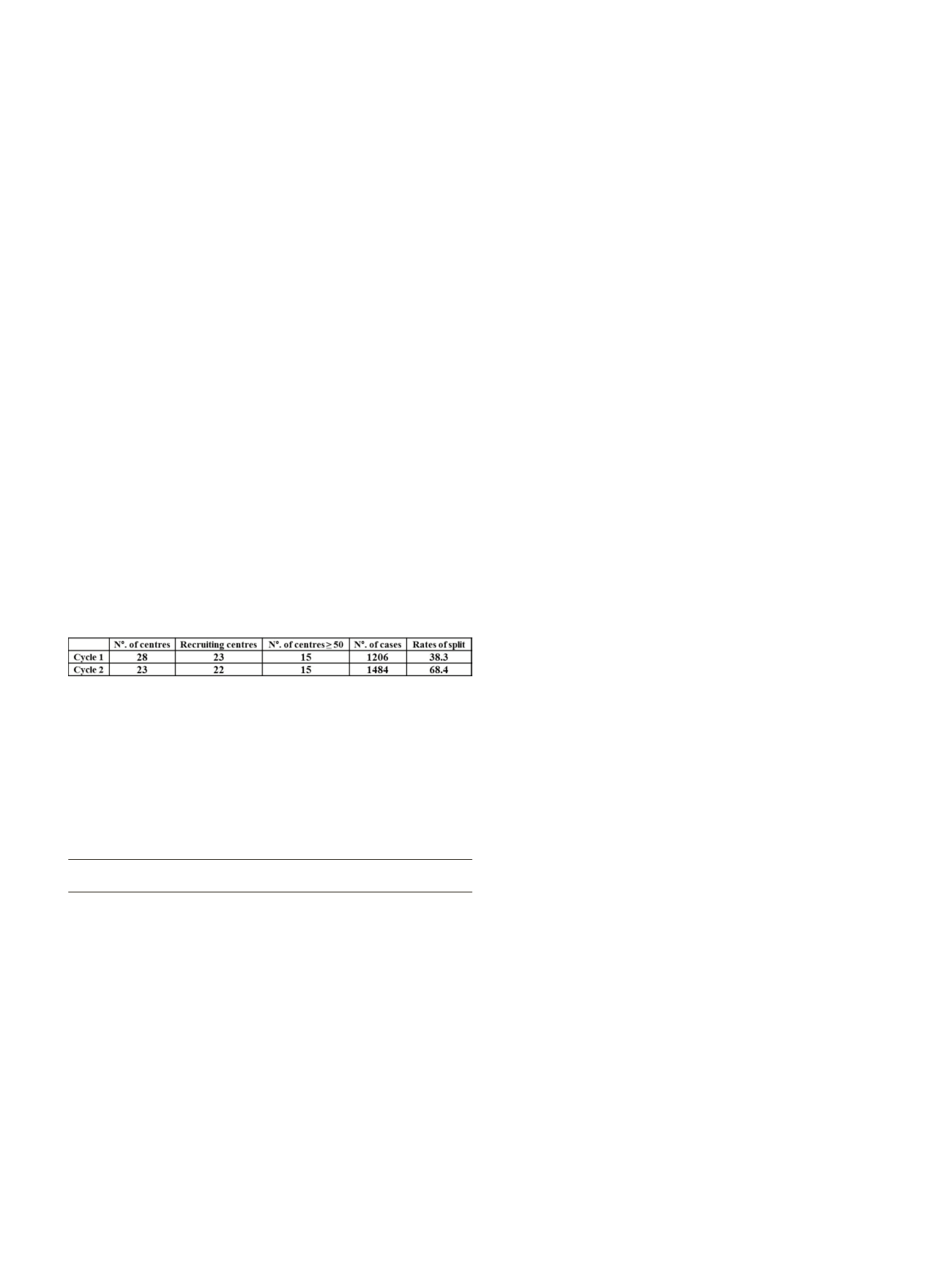
The baseline rate of split-dosing plus same day was 38.3
(1.3% same day) with a large variation among centres. Several gaps
and obstacles were identified especially at the organizational and
communication level. Some bowel preparations instructions were
outdated and in some cases did not include split-dosing information.
In general patients did not represent an important barrier to
adopting split-dosing. The major obstacle has been the difficulty to
inform and motivate patients undergoing routine colonoscopy in an
open access regimen who receive written instructions only from
“CUP” (Central booking office). Specific protocols and procedures
have been developed and adopted for screening cases and for in-
patients. Modify the agenda (starting colonoscopy late in the
morning) was not considered feasible for most Endoscopy Units.
Modified split-dosing PEG 4 L (3 liters + 1 liter) was used for early
colonoscopy. Five key areas were identified and targeted for
intervention: 1) Organisation and responsibility 2) Education and
motivation of health care and administrative personnel 3) protocols
and friendly user instructions leaflets 4) Internal and external
communication [e.g. primary care physicians; other referring
hospital dept.] 5) Specific local problems. The preliminary results
from Improves Campania are as follows:
The variation among centres in the rate of split-dosing between pre-
and post-intervention was significantly reduced.
Conclusions:
We were able to achieve a 30% increase in the rate of
split-dosing over one year in a large sample of Endoscopy units in
Campania through a SIED coordinated quality improvement project
which involved a system-wide approach to remove barriers to
change and move toward high quality colonoscopy.
OC.09 Basic Science
OC.09.1
TRANSGLUTAMINASE 2 (TG2) MEDIATES THE CYTOTOXIC EFFECT
OF RESVERATROL IN CHOLANGIOCARCINOMA (CC) CELL LINES
Roncoroni L.*
1
, Elli L.
1
, Braidotti P.
2
, Tacchini L.
3
, Lombardo V.
1
,
Branchi F.
1
, Conte D.
4
, Doneda L.
5
1
IRCCS Cà Granda Ospedale Maggiore Policlinico, Milano, Italy,
2
Pathology Unit, San Paolo Hospital, University of Milan, Milan, Italy,
3
Biomedical Sciences for Health, University of Milan, Milan, Italy,
4
Department of Pathophisiology and Transplantation, University of
Milan, Milan, Italy,
5
Department of Biomedical Surgical and Dental
Sciences, University of Milan, Milan, Italy
Background and aim:
Cholangiocarcinoma (CC) is characterized
by a poor prognosis. As curative medical regimen is currently
unavailable for patient unsuitable for surgery, new drugs are
urgently needed. Resveratrol (RES) has previously been reported to
play a cytotoxic effect on CC cell cultures and the related increase
of type 2 transglutaminase (TG2) involved in carcinogenesis and
apoptosis. Present study was aimed at evaluating if TG2 inhibition
could reduce the cytotoxic effect of RES on CC cell lines.
Material and methods:
CC cell lines SK-CHA-1 and MZ-CHA-1,
grown on a three dimensional cell culture model, were treated for
72 hours with RES (64 microM, after a dose finding preliminary
study) alone or combined with TG2 inhibitors (cystamine and
two selectives ones, B003 and T101). The following points were
investigated: cell viability (clonigenic test), cell morphology (light
microscopy -LM, transmission electron microscopy -TEM and
immunoistochemistry-IMC), Q-banding (karyotype analysis), and
TG2 analysis (colorimetric method and Western Blotting).
Results:
RES treatment induced a significant inhibition of cell
growth. The co-treatment RES/TG2 inhibitors prevented growth
inhibition in both cell lines; the cell growth for SK-CHA-1 with RES
64microMand the three different inhibitors (respectively cystamine,
B003 and T101) increased of the 24%, 42% and 76% vs. percentage
of colony growth from cells treated only with RES; for MZ-CHA-1
the cell growth increase was of 75%, 33% and 83% (cystamine, B003
and T101) vs. percentage of colony growth from cells treated only
with RES. LM, TEM and IHC results demonstrated a partial protection
with T101. The normalization of cell growth was associated to an
inhibition of TG2 activity both in MZ-CHA-1 (85% with cystamine,
60% with B003 and 45% with T101 vs.100% controls) and SK-CHA-1
(95% with cystamine, 30% with B003 and 15% with T101 vs. 100%
controls).
Conclusions:
Our data demonstrated that the cytotoxic effect of RES
in SK-CHA-1 and MZ-CHA-1 is TG2 mediated.
OC.09.2
THE EXTRACELLULAR MATRIX PROTEIN EMILIN2 AS A
REGULATOR OF THE MYELOID RESPONSE IN A MODEL OF
INFLAMMATION-INDUCED COLON CARCINOGENESIS
Andreuzzi E.*
1
, Tarticchio G.
1
, Di Carlo E.
2
, Todaro F.
1
, Marastoni S.
4
,
Paulitti A.
1
, Pellicani R.
1
, Colombatti A.
1
, Cannizzaro R.
3
, Mongiat M.
1
1
Experimental Oncology Division 2, CRO-IRCCS, Aviano, Italy,
2
Department of Oncology and Experimental Medicine, Università
di Chieti-Pescara, Chieti, Italy,
3
Gastroenterology Unit, CRO-IRCCS,
Aviano, Italy,
4
MaRS Discovery District, Toronto, Canada
Background and aim:
EMILIN2 is an extracellular matrix molecule
belonging to the EMI Domain ENdowed (EDEN) protein family
that exerts pleiotropic effects in the tumor microenvironment
overall functioning as a tumor suppressive molecule. EMILIN2
affects tumor cell viability and proliferation by activating apoptosis
and functioning as a negative regulator of the Wnt/
b
-catenin
axis. Interestingly EMILIN2 expression is down-modulated by
methylation in a number of tumors including breast and colorectal
cancer. Given its involvement in the regulation of Wnt signaling, a
crucial pathway in colon carcinogenesis, and its altered expression
in colorectal cancer, we took advantage of the EMILIN2 null mouse
model to assess its role in colorectal cancer (CRC) development,
subjecting the mice to the inflammation-related AOM/DSS protocol.
Material and methods:
Colorectal tumors were induced subjecting
the mice to a AOM/DSS treatment. Tumor development was
assessed by colonoscopy. Histopathological and IHC analyses were
performed on colon samples from treated mice.
b
-catenin activation
was assessed by Western blot and qPCR. Multiplex serum cytokine
analyses from the two mouse models were performed through
Luminex Screening and peripheral blood cells were counted. The
inflammatory infiltrate was analysed by flow cytometry.
Results:
The EMILIN2 KO mice developed a significantly higher
number of tumors compared to wt mice. Tumors from EMILIN2 KO
mice were more undifferentiated and at an advanced stage compared