


 103 / 172

e164
Abstracts of the 22
nd
National Congress of Digestive Diseases / Digestive and Liver Disease 48S2 (2016) e67–e231
= 2.7-17.9) at baseline and 9.1 (IQR = 4.1-17.7) after a median of
20.7 months (IQR = 10-27.5). History of surgical resections (P <
0.0001), stricturing or penetrating behaviors (P = 0.0041) and a
disease duration ≥10 years (P < 0.0001) were predictive of higher LI
value at first evaluation. At follow-up, LI increased in 13, remained
unchanged in 9 and decreased in 6 patients. LI was more likely to
increase in colonic localizations (median delta LI 2.5 versus 0.0; P
= 0.34) and in patients with a disease duration <10 years (median
delta LI 0.625 versus 0.0; P = 0.059). LI’s progression showed no
correlation with CRP levels and CDAI. Immunosuppressive or anti-
TNF
a
treatments were associated with slightly higher LIs at baseline
(median LI 13.8 vs 6.35, P = 0.09), and no improvement at the follow-
up evaluation (Delta LI 0.26 vs -0.60; P = 0.18).
Conclusions:
The newly introduced LI is a feasible tool to assess
BD in CD. This study confirms that surgical history, complicated
disorders or long duration are independent predictors of BD. These
data suggest for the first time that patients with colonic locations
or with a recent diagnosis of CD have an increased risk of BD
progression, thus suggesting that early therapeutic intervention may
reduce damage progression. Further studies should now evaluate
the impact of assessing LI in clinical and experimental therapeutic
strategies.
References:
1. Pariente B, et al. Gastroenterology 2015;148(1):52-63.e3.
P.07.17
A NEW THERAPEUTIC LASER SYSTEM FOR HEMOSTATIC
TREATMENTS IN GI ENDOSCOPY – FIRST RESULTS IN AN
ESTABLISHED ANIMAL MODEL
Tontini G.E.*
1
, Neumann H.
2
, Carmignani L.
3
, Bruni B.
4
, Pastorelli L.
1
,
Cavallaro F.
1
, Fagnani F.
5
, Clemente C.
4
, Bottani M.
1
, Vecchi M.
1
1
Gastroenterology & Digestive Endoscopy Unit, IRCCS Policlinico San
Donato, San Donato Milanese, Milano, Italy,
2
Department of Medicine
I, University of Erlangen-Nuremberg, Erlangen, Germany,
3
Academic
Urology Department, IRCCS Policlinico San Donato, San Donato
Milanese, Milano, Italy,
4
Pathology and Citodiagnostic Unit, IRCCS
Policlinico San Donato, San Donato Milanese, Milano, Italy,
5
Surgical
Division, Quanta System S.p.A, Varese, Italy
Background and aim:
The Thulium laser system is an established
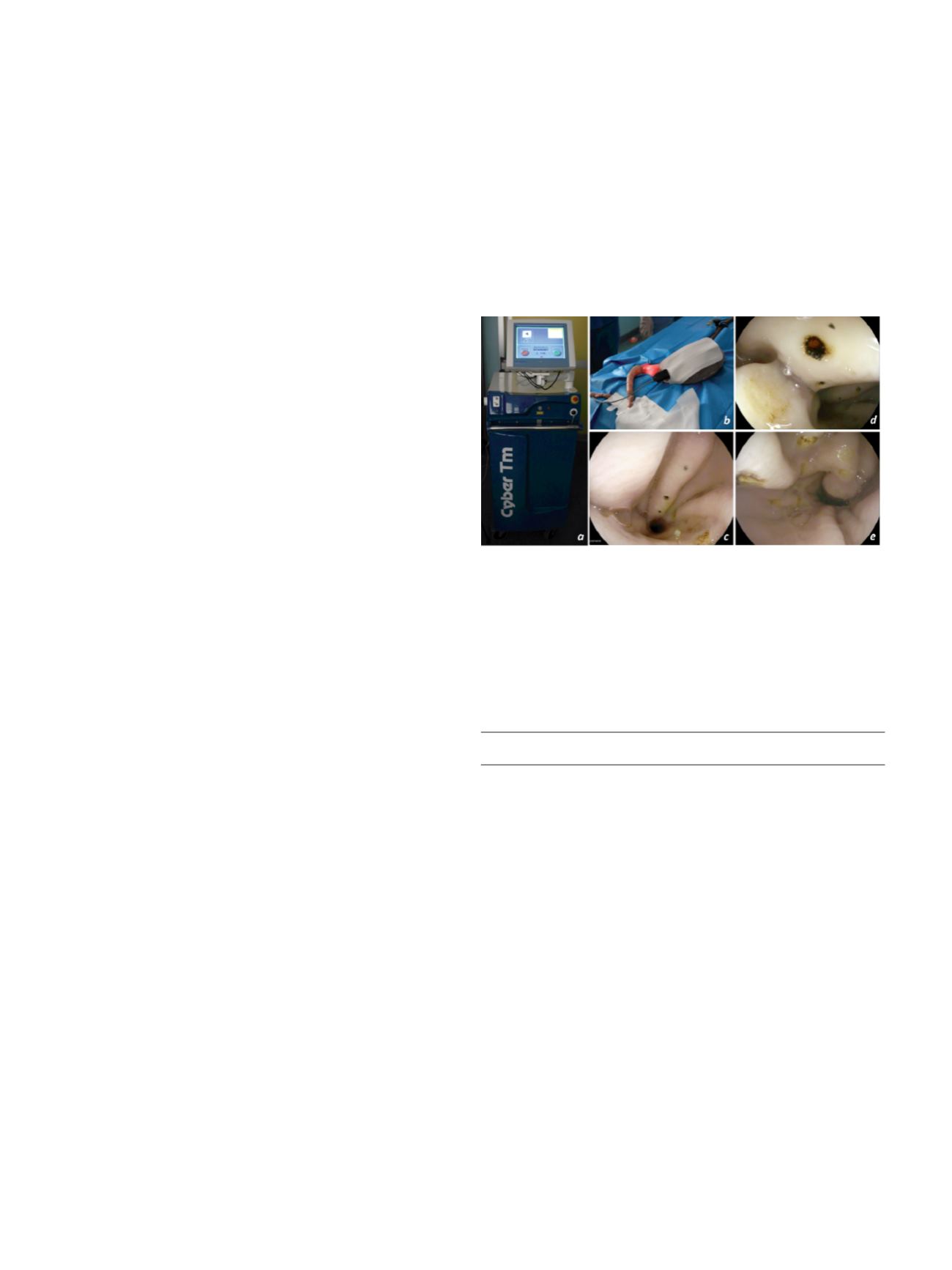
therapeutic technology for surgical resection [1-3; fig. a]. The
wavelength of 2μm is strongly absorbed by water present in soft
organic tissues, thereby providing constant speed of cutting and
vaporization (i.e. “vaporesection”) regardless of vascularization,
with high degree of control on the penetration depth (0.2-0.4mm)
to reduce the risk of inadvertent deep injury. However, no study
has yet reported its use for achieving hemostasis in the luminal
gastrointestinal (GI) tract. We conducted a pilot study in an
established animal model (EASIE; fig. b) to test for the first time
the safety and efficacy of the Thulium Laser system (Cyber TM®,
Quanta System, Varese, Italy) for hemostatic treatment in luminal
GI-endoscopy.
Material and methods:
Various optical fibers (365 and 550 um)
were evaluated with different power settings (10, 15, 20, and 25
watts), and diverse configurations (continued laser shaping or pulse
modality). Study endpoint was to assess the impact of the device in
terms of depth penetration and lateral tissue damage under a laser
exposure prolonged for 3, 5 and 7 seconds at fixed distance (0.5-1
cm) from the mucosal surface. Results were compared to the effect
of Argon Plasma Coagulation (APC) generated by an established
standard electrosurgery system for hemostatic therapy in the
luminal GI-tract with a 2.3 mm catheter using 20, 40 and 60 watts.
All procedures were performed using a standard video-gastroscope
and digitally recorded. Histopathological analysis based on the
whole stomach were performed by an expert GI pathologist.
Results:
Neither transmural perforation, nor any muscular layer
damage was observed with both systems used. A progressive
penetration depth and tissue damage was observed with increased
laser power and APC settings, as well as with prolonged tissue
exposure. Nonetheless, both the fiber diameter and the configuration
modality of the laser system were found to have no impact on depth
penetration and tissue damage, with only marginal effect on the
lateral spread of vaporization. Overall, the laser system was
associated with a comparable degree of vertical tissue injury (from
0.1 to 2.0 mm) and a much more precise effect on target according to
a lower lateral spreading damage (0.1-0.3 mm and 0.2-0.7 mm using
the 365 and 550 um fiber, respectively; fig. c-d) compared to APC
(1.1-1.6 mm; fig. e).
Conclusions:
The Thulium laser system appears to be safe and
effective for hemostatic therapy in an ex vivo animal model of the
upper GI-tract. In vivo studies should now confirm these initial
results in a prospective setting.
References:
1. Rieken M & Bachmann A. Nat Rev Urol 2014
2. Carmignani L, et al. Asian J Androl 2015
3. Marulli G, et al. Lasers Med Sci 2013
P.08 Esophagus
P.08.1
ABNORMAL INTRA-BOLUS PRESSURE CORRELATES WITH
ESOPHAGO-GASTRIC DYSFUNCTION AND ITS AGE-RELATED
MODIFICATION – A STUDY USING HIGH-RESOLUTION
MANOMETRY
Della Coletta M.*
1
, Galeazzi F.
1
, Marabotto E.
2
, De Bortoli N.
3
,
Marchi S.
3
, Tolone S.
4
, Savarino V.
2
, Savarino E.
1
1
Divisione di Gastroenterologia, Dipartimento di Chirurgia, Oncologia
e Gastroenterologia, Università di Padova, Padova, Italy,
2
Divisione di
Gastroenterologia, Dipartimento di Medicina Interna, Università di
Genova, Genova, Italy,
3
Divisione di Gastroenterologia, Dipartimento di
Medicina Interna, Università di Pisa, Pisa, Italy,
4
Divisione di Chirurgia
Generale e Bariatrica, Dipartimento di Chirurgia, Seconda Università
di Napoli, Napoli, Italy
Background and aim:
High Resolution Manometry (HRM) is
currently considered the gold standard to assess esophageal
peristalsis and esophago-gastric junction (EGJ) function. Indeed,
with the use of this technology novel validated metrics have
been developed to define esophageal motility abnormalities. In
particular, the intrabolus pressure (IBP) has been initially regarded
as an indirect measure of bolus transit trough the EGJ, although the
last iteration of Chicago Classification lacks of its adoption because