


 123 / 172

e184
Abstracts of the 22
nd
National Congress of Digestive Diseases / Digestive and Liver Disease 48S2 (2016) e67–e231
inspection of the slides by the endosonographer, in the absence of a
microscopic rapid on-site evaluation (ROSE), can increase FNA
adequacy, thus allowing to complete the procedure with a limited
number of needle passes.
Material and methods:
We retrospectively evaluated our FNA
procedures on solid pancreatic lesions when the cytopathologist
was absent and the endosonographer smeared, observed and fixed
the slides by himself. A standard 22G or 25G needle was moved
in the target lesion without suction and the aspirated material
was expelled on slides by blowing air. The slides were smeared
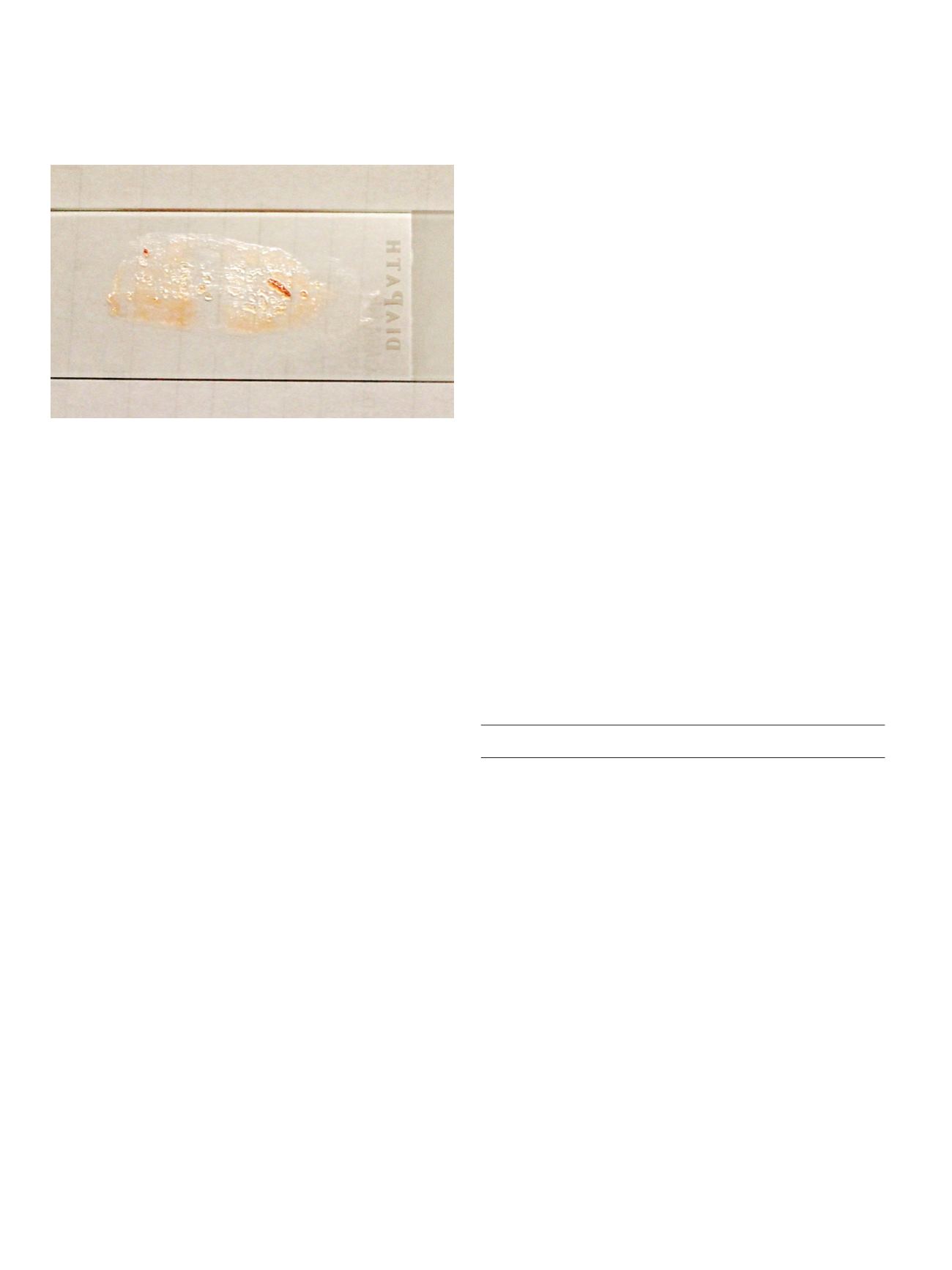
and observed with oblique white light: when thin granular or
filamentous whitish or pink material was visible and blood was
poor, the slides were considered adequate and they were fixed with
alcohol. When blood or clots were predominant the smears were
eliminated. When no material was present in the needle, suction
was applied in the next needle passes. The procedure was closed,
regardless of the number of needle passes, when 5 slides were
judged satisfactory. For each case the number of needle passes and
the final microscopic adequacy were recorded.
Results:
Overall 100 patients entered the study. A mean of 4.1
(range 1-7) needle passes were effected. Microscopic adequacy
was achieved in 95 cases (95.0%): 74 pancreatic adenocarcinoma,
3 neuroendocrine tumor, 3 atypical pancreatic cells, 11 benign
pancreatic cells, 2 lymphoma, 2 benign lymphocytes. Most
procedures were ruled out with a 22G needle, which got an adequate
sample in 79 out of 84 (94.0%) cases; the 25G needle was used only
16 times, all resulting adequate (100%) (p = n.s.). No complications
occurred.
Conclusions:
Although the best technique for improving the
performance of pancreatic FNA still seems ROSE, either its cost or its
low diagnostic gain in centers with an already high accuracy limits
its availability. We suggest a simple, rapid and cheap alternative
to ROSE; the visual inspection of the smeared slides could help
choosing those with abundant diagnostic material, hence increasing
FNA adequacy and reducing the number of needle passes.
P.11.8
THE ROLE OF EUS-FNA IN THE DIAGNOSIS OF PANCREATIC
NEUROENDOCRINE TUMORS
Carrara S.*, Rahal D., Zerbi A., Anderloni A., Di Leo M.,
Di Tommaso L., Loriga A., Federico D., Repici A.
Humanitas Research Hospital, Rozzano, Italy
Background and aim:
One of the most controversial issue in the
diagnosis of pancreatic neuroendocrine tumors (NET) is the accurate
prediction of their clinical behaviour. According to the ENETS and
WHO 2010 criteria the grading for pancreatic NET has to be expressed
by using the mitotic index and the Ki67 proliferation index. The aim
of this study was to evaluate the of the EUS-FNA in the diagnosis and
grading of pancreatic NET.
Material and methods:
We retrospectively reviewed all consecutive
patients referred to our Unit with a radiological finding suspicious
for NET.A computerized system was used to extrapolate the list of
patients with NET in the field of pancreatic EUS between May 2014
and Oct 2015. EUS was performed with the linear array Olympus
GF-UCT-180 series echoendoscopes in combination with the
echoprocessor EU-ME2. FNA was performed with Beacon or Boston
Scientific 25G or 22G needles. Forty-nine patients undergoing EUS
were identified with 24 having also FNA. Adequacy of the aspirated
material was assessed by Rapid On Site Evaluation (ROSE) and
fragments observed on slide at macroscopic evaluation were placed
in formalin for histology evaluation. In patients undergoing surgery
the EUS-FNA results were compared with final histological diagnosis.
Results:
Patients population included 9 women and 15 male (mean
age 58 years). Fourteen patients (58%) had an incidental finding of
pancreatic mass, 2 (9%) had genetic syndrome and the others (33%)
had symptoms like pain, weight loss or jaundice. All the cases were
non-functioning. Clinical and technical data are summarized in the
Table. In 2 cases the procedure was interrupted before the adequacy
was obtained because of a mild self-limited bleeding. The
combination of cytology and histology reached an adequacy of 92%
(the 2 inadequate cases were those in which a bleeding was
observed) and gave a ki67 result in 15 cases (62.5%). The final
diagnosis was obtained with EUS-FNA in 22 cases (92%). Six patients
underwent surgery (25%): 4 distal pancreatectomy, one enucleation,
and one Whipple resection; 8 patients are waiting for surgery; 4 are
in follow up, 1 had chemotherapy, 5 are lost at follow up. In 3
patients who underwent surgery who had a ki67 result on the EUS-
FNA report, there was a 100% correspondence between FNA and
resected specimen.
Conclusions:
The combination of cytology and histology from EUS-
FNA is an effective method for the diagnosis of pancreatic NET and
ki67 index grading for WHO 2010 classification.
P.12 Coeliac Disease 2
P.12.1
GLUTEN-FREE DIET DOES NOT INFLUENCE THE OCCURRENCE
AND THE TH1/TH17-TH2 NATURE OF IMMUNE-MEDIATED
DISEASE IN PATIENTS WITH COELIAC DISEASE
Imperatore N.*
1
, Tortora R.
1
, Capone P.
1
, Donetto S.
2
, De Palma G.D.
3
,
Gerbino N.
1
, Rea M.
1
, Caporaso N.
1
, Rispo A.
1
1
Gastroenterology “Federico II” University, Naples, Italy,
2
Department
of Education and Professional Studies, King’s College London, London,
United Kingdom,
3
Surgical Endoscopy “Federico II” University, Naples,
Italy
Background and aim:
Even though coeliac disease (CD) is
considered to be the most common lymphocyte T helper-1 (Th-1)
mediated enteropathy in Western countries, it seems that Th1-
and lymphocyte T helper-2 (Th-2 )-mediated diseases could co-
exist in CD patients. The aims of the study were: 1) to establish the
prevalence of immune-mediated disorders at time and after CD
diagnosis; 2) to evaluate a possible change in immune response after
starting gluten free diet (GFD); 3) to investigate the potential role of
GFD in reducing and/or preventing immune-mediated disorders in
adult CD patients.
Material and methods:
We carried out a database-driven study
including all consecutive adult CD patients followed-up at our
Gastrointestinal Unit. CD diagnosis was made in accordance with the