


 82 / 172

Abstracts of the 22
nd
National Congress of Digestive Diseases / Digestive and Liver Disease 48S2 (2016) e67–e231
e143
Background and aim:
H. pylori infection is the main cause of
gastritis and as a consequence of upper GI symptoms. On the
other hand, several studies reported a seasonal variation of the
occurrence of upper GI symptoms. Usually, the occurrence or
exacerbation of upper GI symptoms is the main reason why patients
perform 13C-Urea Breath Test (UBT). The aim of our study was to
assess whether there is a seasonal variability of the number of UBT
performed in our outpatient facility.
Material and methods:
We enrolled 1438 consecutive patients
(920F and 515M, mean age 49 ±17), from May 2014 to April 2015,
except for August when the facility was closed, who performed UBT
for the first time for upper GI symptoms. We collected data and
analyzed them comparing the number of the tests performed each
month.
Results:
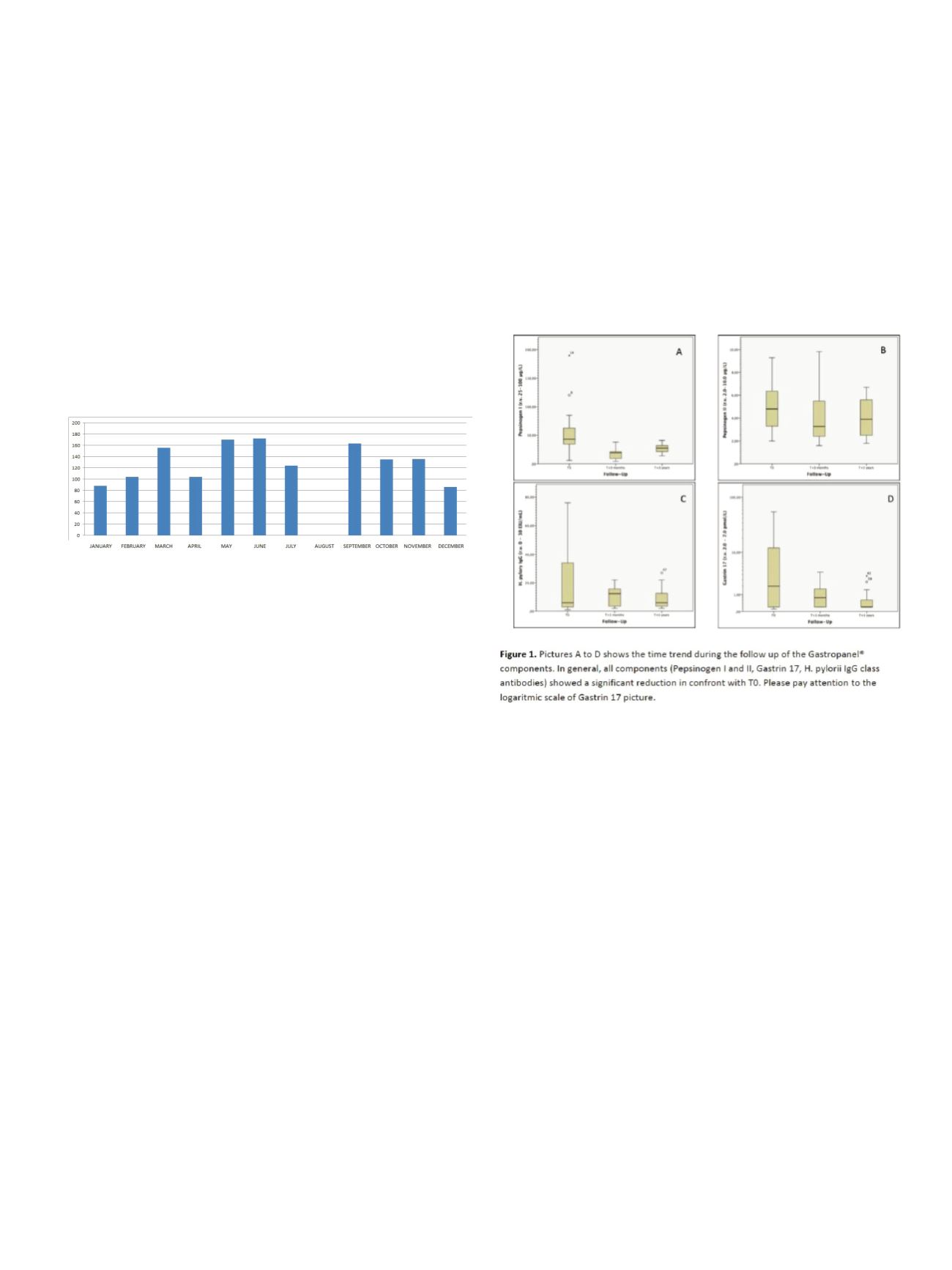
We observed a monthly fluctuation of the number of UBT
performed; lower values were obtained in December and January,
while the highest values in May and June (p<0.0001). By stratifying
the data for each season, spring was the one with the highest
number of UBT performed compared to winter (p<0.001).
Conclusions:
There are solid evidences to conclude that there is a
strong correlation between seasonal exacerbation of gastritis, upper
GI symptoms and number of UBT performed. The lowest number
of UBT has been performed in December and January. Compared to
previous studies there has been a shift from April to May/June and
from October to November.
P.04.2
MORPHO-FUNCTIONAL MODIFICATIONS OF THE GASTRIC
REMNANT AFTER ROUX-EN-Y GASTRIC BYPASS (RYGB): THE (NOT
SO) SPLEEPING REMNANT?
Marchesi F.
1
, De Sario G.
1
, Forlini C.*
1
, Rizzi N.
1
, Tartamella F.
1
,
Ricco’ M.
2
, Caleffi A.
1
, Di Mario F.
3
1
Azienda Ospedaliero Universitaria di Parma, Parma, Italy,
2
Azienda
Provinciale per i Servizi Sanitari della Provincia Autonoma di Trento,
Trento, Italy,
3
Dipartimento di Medicina Clinica e Sperimentale,
Università di Parma, Parma, Italy
Background and aim:
The endoscopic inaccessibility of the excluded
stomach after Roux-en-Y gastric bypass (RYGB) still represents an
unsolved issue for this kind of procedure. The aim of this study is
to evaluate the morpho-functional modifications of the gastric
remnant by using an immunoenzymatic test already validated for
non-bariatric patients: the Gastropanel®.
Material and methods:
A cohort of 20 patients submitted to RYGB
was prospectively enrolled and evaluated preoperatively, at 3
months and 3 years postoperatively. In addition to Gastropanel®
data (Pepsinogen I, Pepsinogen II, Gastrin 17, and anti-H.pylori IgG
class antibodies), biometrical and clinical data were registered.
Continous variables were confronted through Kruskal-Wallis for
indipendent samples. A multivariate analysis was then performed
by calculating a general linear model: Pepsinogen I, Pepsinogen II,
Gastrin 17 and H. pylorii IgG were taken in account as dependent
variables, whereas BMI and age were evaluated as covariates and
sex was considered as a fixed factor. All calculations were performed
with SPSS 22.0.
Results:
In general, all Gastropanel® elements showed a reduction
during follow up in respect of T0 samples. In Pepsigen I (p < 0.001)
and Gastrin 17 (p = 0.044), the model appeared of statistical
significance, whereas for Pepsinogen II (p = 0.349) and H. pylorii IgG
class antibodies (0.817) the observed reduction in serological values
appeares not stasticially significant. When the general linear model
was applied, statistical difference among stages was confirmed both
for G17 and Pepsinogen 1 (p < .0001 in both cases), whereas
correction for BMI and age of patients at the start of follow up
suggested a significant trend for H.pylorii (p = 0.084). Interestingly
enough, multivariate model showed as Pepsinogen I and not G17
main determinant was BMI at the time of sample, suggesting the
results as a direct effect of reduced weight rather than a physiological
consequence of the stomach exclusion.
Conclusions:
RYGB, compared to LAGB, produces, along with a
higher weight loss and comorbidity resolution, a higher QoL, more
evident starting from 6 month postoperative and more significant at
12 month. The change of QoL, is dependent on type of intervention
(RYGB), independent from BMI preoperative and from changes
of comorbidities during the follow up. Satisfaction intervention,
appears greater in patients undergoing RYGB, directly proportional
to reduction of BMI, negatively to SF-36 and independent from
resolution of comorbidities. An additional parameter for assessing
the effectiveness of the intervention of RYGB, is the best food
dissatisfaction compared to LAGB.
P.04.3
SERUM PEPSINOGEN II LEVELS AND IGG ANTI HELICOBACTER
PYLORI ANTIBODIES MAY REPRESENT A NON-INVASIVE METHOD
FOR THE DIAGNOSIS AND MONITORING OF H PYLORI-RELATED
GASTRITIS
Franceschi M.
1
, Panozzo M.P.
2
, Messina O.*
1
, Ferronato A.
1
, Tomba F.
1
,
Sella D.
1
, Antico A.
2
, Di Mario F.
3
, Baldassarre G.
1
1
1. Endoscopic Unit, Department of Surgery, ULSS 4 Alto Vicentino,,
Santorso (VI), Italy,
2
2. Department of Clinical Pathology, ULSS4
Alto Vicentino, Santorso (VI), Italy,
3
3. Departments of Clinical and
Experimental Medicine, University of Parma, Parma, Italy
Background and aim:
Serum concentration of Pepsinogen II
(PGII) increases in patients affected by chronic gastritis due to Hp
infection; this enhancement is correlated to the degree of gastric