


 84 / 172

Abstracts of the 22
nd
National Congress of Digestive Diseases / Digestive and Liver Disease 48S2 (2016) e67–e231
e145
P.04.6
PREVALENCE OF H. PYLORI INFECTION IN SEXUAL PARTNERS OF
H. PYLORI INFECTED SUBJECTS: ROLE OF GASTROESOPHAGEAL
REFLUX
Sgambato D.*, Visciola G., Tuccillo C., Miranda A., Federico A.,
Alagia V., Ranaldo R., Ormando V., De Sio I., Loguercio C.,
Romano M.
Department of Internistica Clinica e Sperimentale, “F Magrassi e A
Lanzara”, Hepato-gastroenterology Unit, Second University of Naples,
Naples, Italy
Background and aim:
Transmission of H. pylori infection is through
fecal-oral or oral-oral routes. Whether H. pylori infection is more
prevalent in sexual partners of H. pylori-infected subjects is not
completely clear. Our aim was to evaluate the prevalence of H.
pylori infection in sexual partners of H. pylori-infected subjects.
Also we evaluated the prevalence of gastroesophageal reflux (GER)
symptoms in H. pylori-infected subjects and their sexual partners.
Material and methods:
We studied 100 H. pylori-infected subjects
(M, F, age range, median age) and their sexual partners (M, F, age
range, median age). Control group consisted of 100 dyspeptic
subjects matched for sex and age; 2) H. pylori infection was assessed
by 13C Urea Breath Test (UBT); 3) prevalence of upper GI symptoms,
including GER symptoms, was assessed through the Leeds scale; 4)
significance of differences was assessed by chi-square test and a p
value of < 0.05 was considered statistically significant.
Results:
1) Prevalence of H. pylori infection in sexual partners of
H. pylori-infected subjects was 75/100 (75%) whereas prevalence of
H. pylori infection in the control group was 33/100 (33%), p<0.05;
2) in the 75 couples with both members infected with H. pylori,
prevalence of GER symptoms in at least one member of the couple
was 50/75 (67%) whereas in the 25 couples with no transmission of
H. pylori infection, prevalence of GER in H. pylori-infected subjects
was 10/25 (40%), p<0.05.
Conclusions:
1) Prevalence of H. pylori infection is significantly
higher in sexual partners of H. pylori-infected subjects than in a
control group of dyspeptic patients; 2) Prevalence of GER symptoms
is significantly higher in H. pylori-infected subjects whose sexual
partner is H. pylori-infected than in those whose sexual partner is
not; 3) We hypothesize that sexual partners of H. pylori-infected
subjects are at risk of being in-fected and that therefore should be
tested for H. pylori infection; 4) We postulate that transmission of
H. pylori infection might be, at least in part, contributed to by GER,
probably through an oral-oral route.
P.04.7
PREVALENCE OF H. PYLORI INFECTION AMONG PATIENTS
COMING FROM DIFFERENT COUNTRIES AND LIVING IN ROME
AREA
Petruzziello C., Tesori V., Graziani C., Franceschi F., Gasbarrini A.,
Ojetti V.*
Università Cattolica del Sacro Cuore, Roma, Italy
Background and aim:
Rome is a multi-ethnic metropolis and many
patients, Italians or non-Italians are referred to our outpatients
Gastroenterology unit to perform 13C-urea breath test (UBT) because
of the occurrence of upper GI symptoms. The aim of this study was
to assess the prevalence of Helicobacter pylori (HP) infection and
DOB values in Italian and non-italian patients.
Material and methods:
258 patients (198F; 60M, mean age 47±15
years) performed UBT between November 2014 and April 2015 in
our Gastroenterology Unit according to international guidelines.
We considered positive to HP infection with a DOB>3.5%. Among
patients, 138 (104F 34M, mean age 48±17 years) were Italians,
meanwhile 120 (94F 26M, mean age 46±13 years) were from
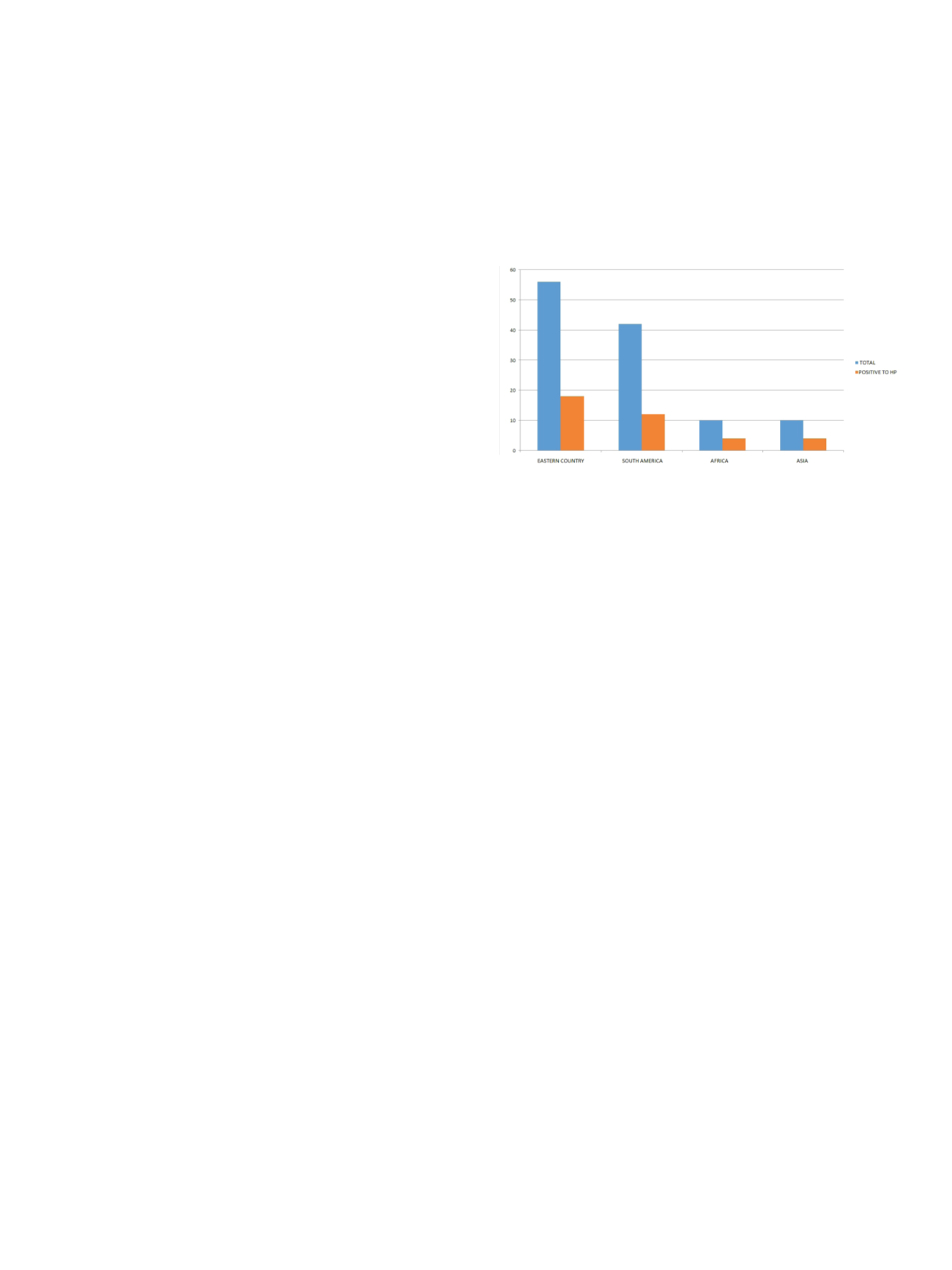
different countries, as assessed by the place of birth (56 Eastern
Countries, expecially from Romania, 42 South America, Ecuador
above all, 10 Africa and 10 Asia).
Results:
Among 138 Italian patients, 23% resulted infected by HP,
compared to 37% of non-Italians subjects (p<0.04).
The positivity of HP infection among patients fromEastern Countries,
South America, Africa and Asia were 32%, 28%, 40%, 40% respectively.
Interestingly, we found significant lower DOB values in Italians
compared to non-Italian patients (mean DOB 36±27 vs 69±32;
p<0.0001).
Conclusions:
Our data shows that around 50% of pts referred to our
outpatients unit come from foreign Countries and most of them are
from Eastern Europe. Prevalence of HP is lower in Italians compared
with non-Italian patients, with a significantly lower level of DOB
value, which deserves further investigations.
P.04.8
PREVALENCE OF H. PYLORI INFECTION IN A POPULATION OF
ITALIANS AND IMMIGRANTS IN ROME AND RATE OF RESPONSE
TO THERAPY
Nosotti L.*, Petrelli A., Caruso A., Rossi A., Costanzo G., Fortino A.,
Mirisola C.
National Institute for Health, Migration and Poverty (NIHMP), Rome,
Italy
Background and aim:
It is estimated that Helicobacter Pylori (HP)
infection affects approximately half of the world’s population,
causing diseases such as gastritis, peptic ulcer and gastric neoplasms.
Although its impact in developed countries has been reduced
over the last decades, the prevalence of the disease remains high,
equal to 10-20% in individuals under the age of 50 and to 40-50% in
individuals over the age of 50.
However in developing countries, the prevalence of the infection
is higher compared to developed countries (reaching up to 90% in
some African and Asian countries).
Aims of the study are: 1) to assess the prevalence of HP infection in
a population of Italians and immigrants with chronic dyspepsia 2) to
evaluate the rate of responders to first line therapy.
Material and methods:
Between January 2014 and February 2015,
366 patients with dyspeptic symptoms attending the outpatient
clinic of NIHMP were visited. Among these, 311 were submitted to
urea breath test (UBT) for the diagnosis of HP infection.
The distribution by gender demonstrates a slight prevalence of
males (51.4%) with a mean age of 43.1 years. The distribution
of patients, related to the geographical areas of origin, was the
following: Europe 50.2% (of which Italy was 23.5%), Africa 29.3%,
Asia 10%, South America 10.6%.
HP positive patients after UBT were submitted to first line therapy.
First line therapy was differentiated on the basis of the country of
origin: individuals from countries with a high percentage (>20%) of
antibiotic resistance to clarithromycin (Europe, Asia) were treated