


 89 / 172

e150
Abstracts of the 22
nd
National Congress of Digestive Diseases / Digestive and Liver Disease 48S2 (2016) e67–e231
typing. We asked the patient to restart gluten-free diet. EGDS
was performed in 2015 (after 18 month) and showed a normal
duodenum mucosa. Histological exam showed no villous atrophy,
not inflammatory infiltrate. CD diagnosis was confirmed and patient
resolved gastrointestinal manifestation and anemia.
Conclusions:
Villous atrophy can be seen in patients with CVID.
Infectious agents may be responsible, whereas in others, CD may be
the cause. Our case report demonstrates that celiac antibodies gave
conflicting results and were of no help in CVID diagnosis. HLA-DQ
typing is important for exclusion of CD. Histologic response to a GFD
allowed a diagnosis of CD and remains the only diagnostic criteria
for CD.
P.05.7
SYSTEMATIC REVIEW AND META-ANALYSIS OF STUDIES
COMPARING METAL OR PLASTIC STENTS FOR PREOPERATIVE
BILIARY DRAINAGE IN RESECTABLE PANCREATIC CANCER
Belfiori G.*
4
, Crippa S.
1
, Cirocchi R.
2
, Arcidiacono P.G.
3
, Partelli S.
1
,
Salandini M.C.
1
, Muffatti F.
1
, Falconi M.
1
1
Division of Pancreatic Surgery, Vita e Salute University, San Raffaele
Hospital, Milan, Italy,
2
Department of General and Oncologic Surgery,
University of Perugia, St. Maria Hospital, TERNI, Italy,
3
GI UNIT Vita e
Salute University, San Raffaele Hospital, Milan, Italy,
4
Department of
Surgery, Università Politecnica delle Marche, Ospedali Riuniti, Ancona,
Italy
Background and aim:
In resectable pancreatic cancer, preoperative
biliary drainage (PBD) increases complications compared with
early surgery without PBD. However PBD may be necessary in
patients with marked hyperbilirubinemia or in patients undergoing
neoadjuvant therapy. Metal stents seem to be more effective than
plastic stents in these settings.
Material and methods:
Systematic review and meta-analysis of
studies comparing metal versus plastic stents in patients undergoing
endoscopic PBD for resectable pancreatic cancer. Primary outcome
was the rate of endoscopic reintervention (ER), meaning stent
failure of preoperative biliary drainage before surgery. Secondary
outcomes were rate of overall complications related to preoperative
biliary drainage, before and after surgery such as anastomotic
leakage, intra-abdominal abscesses, delayed gastric emptying,
wound infection, portal vein thrombosis, pancreatic fistulas, biliary
anastomotic leak and mortality.
Results:
One Cohort prospective Trial and four retrospective cohort
trials were identified including 704 patients comparing metal vs
plastic stents. Of these, 202 patients (29.5%) were treated with metal
stents and 502 patients (70.5%) with plastic stents. The majority
of patients had a pancreatic adenocarcinoma 610 (86.4%). The
methodological quality assessment for each of the included studies
was considered as “fair”. The rate of ER was significantly lower
in the metal stent group than in the plastic group (3.4% vs 14.8%,
p = 0.0009). In addition, rate of postoperative pancreatic fistulas
resulted significantly lower in the metal stent group 5.1% vs 11.8%
(p=0.04). No significant difference was found in the other secondary
outcomes.
Conclusions:
Even though early surgery remains the standard
preference in most patients suffering from jaundice with a resectable
pancreatic tumour, metal stents should be preferred for PBD when
surgery must be delayed.
P.05.8
RECURRENT LIFE-THREATENING GASTROINTESTINAL BLEEDING
DUE TO MECKEL’S DIVERTICULUM
Criscuoli V.*
1
, Mancuso A.
1
, Fazio V.
2
, Maringhini A.
1
1
Medicine Department - Di Cristina - Benfratelli, Piazza Leotta 4
ARNAS Civico, Palermo, Italy,
2
Surgery Department, Di Cristina
Benfratelli ARNAS CIVICO, Palermo, Italy
Background and aim:
This is a case of a 34 year old man presented
with a further episode of gastrointestinal bleeding (GB) motivating
admission in the department of Medicine.
Material and methods:
His previous history began two years before,
with three episodes of GB, presenting as melena, with haemorrhagic
shock in one occasion, and plenty transfusions during the episodes.
Five upper endoscopic and 6 coloscopic exams, both urgent and
elective, had been performed, only finding an angiodyplasia of the
cecum, that was treated with argon plasma coagulation. Moreover,
no other sources were found at two small bowel capsule studies and
at two enteroscopic exams. After discharge lanreotide was started.
Eleven months later, a new episode on GB occurred. After admission,
melena persisted despite optimal medical treatment. Further urgent
both upper and lower endoscopy, angioCT and angiographic exams,
did not find bleeding sources. Due to the development of
haemorrhagic shock, a surgical emergency procedure was performed
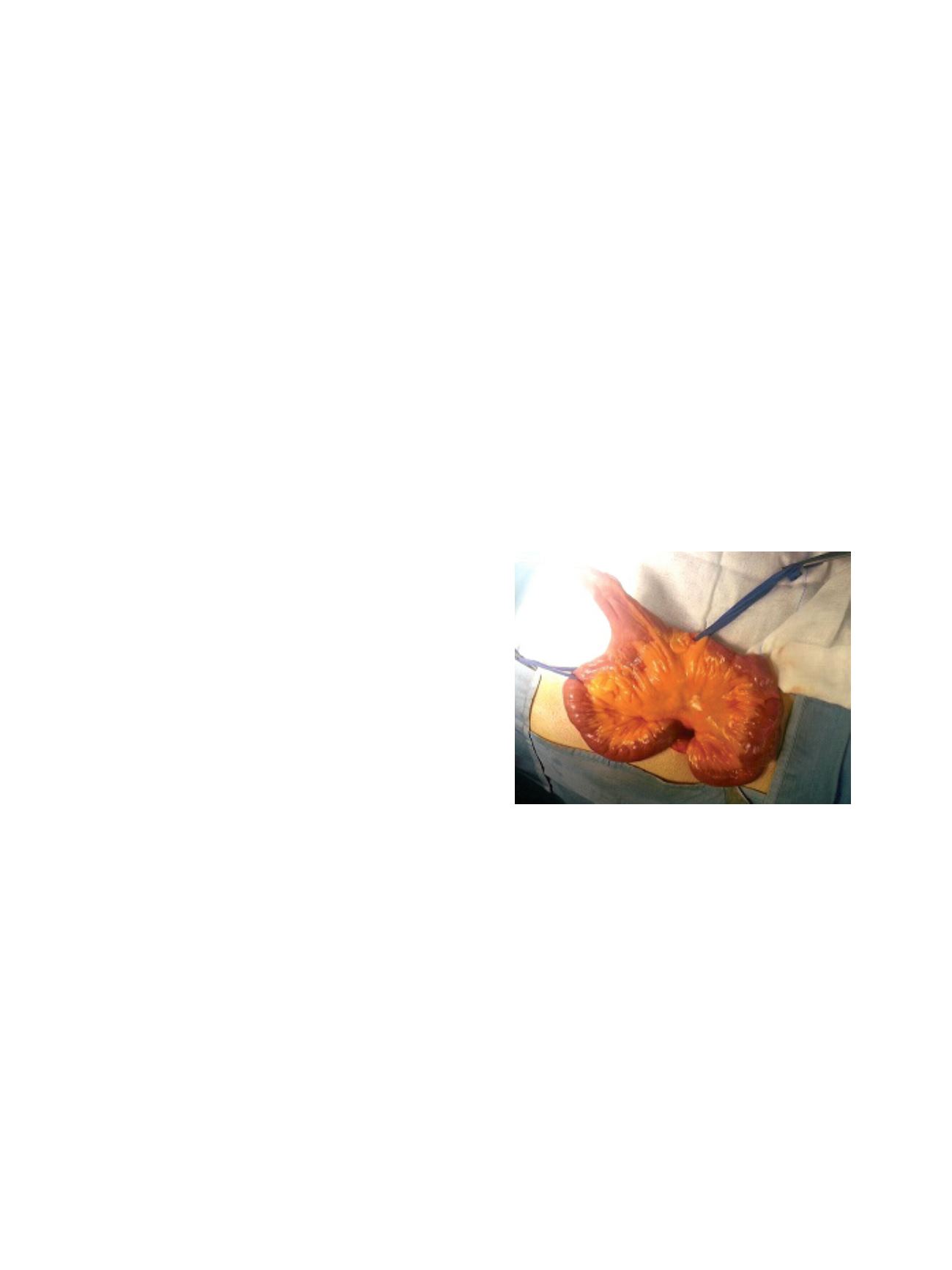
during which Meckel’s diverticulum (MD) with bleeding ulcers was
found and surgically removed at about 60 cm from ileo-cecal valve
(Fig 1).
Results:
Histological examination confirmed MD with ulcerated
ectopic gastric mucosa. The patient was dismissed after few days
and no further episodes of GB occurred during follow up.
Conclusions:
MD is the vestigial remnant of the omphalomesenteric
duct and represents the most common congenital anomaly of the
gastrointestinal tract. MD known complications are intestinal
obstruction, intussusceptions, ulceration, hemorrhage, vesico-
diverticular fistulae and tumors. However, whether GB represents
the most common complications of MD in children, it is a rare
complication in adults. Both endoscopic, radiological exams and
scintigraphy are useful but not always address the diagnosis. Our
report suggests that a diagnosis of MD should be considered in
young adults with recurrent gastrointestinal bleeding of otherwise
unknown cause.
P.05.9
GASTROINTESTINAL NEUROENDOCRINE TUMORS OF UNKNOWN
PRIMARY SITE: REPORT FROM A SERIES AT A SINGLE INSTITUTE
Fanetti I.*, Cavalcoli F., Zilli A., Conte D., Massironi S.
Fondazione IRCCS Ca’ Granda Ospedale Maggiore Policlinico, Unità di
Gastroenterologia ed Endoscopia, Milano, Italy