


 66 / 172

Abstracts of the 22
nd
National Congress of Digestive Diseases / Digestive and Liver Disease 48S2 (2016) e67–e231
e127
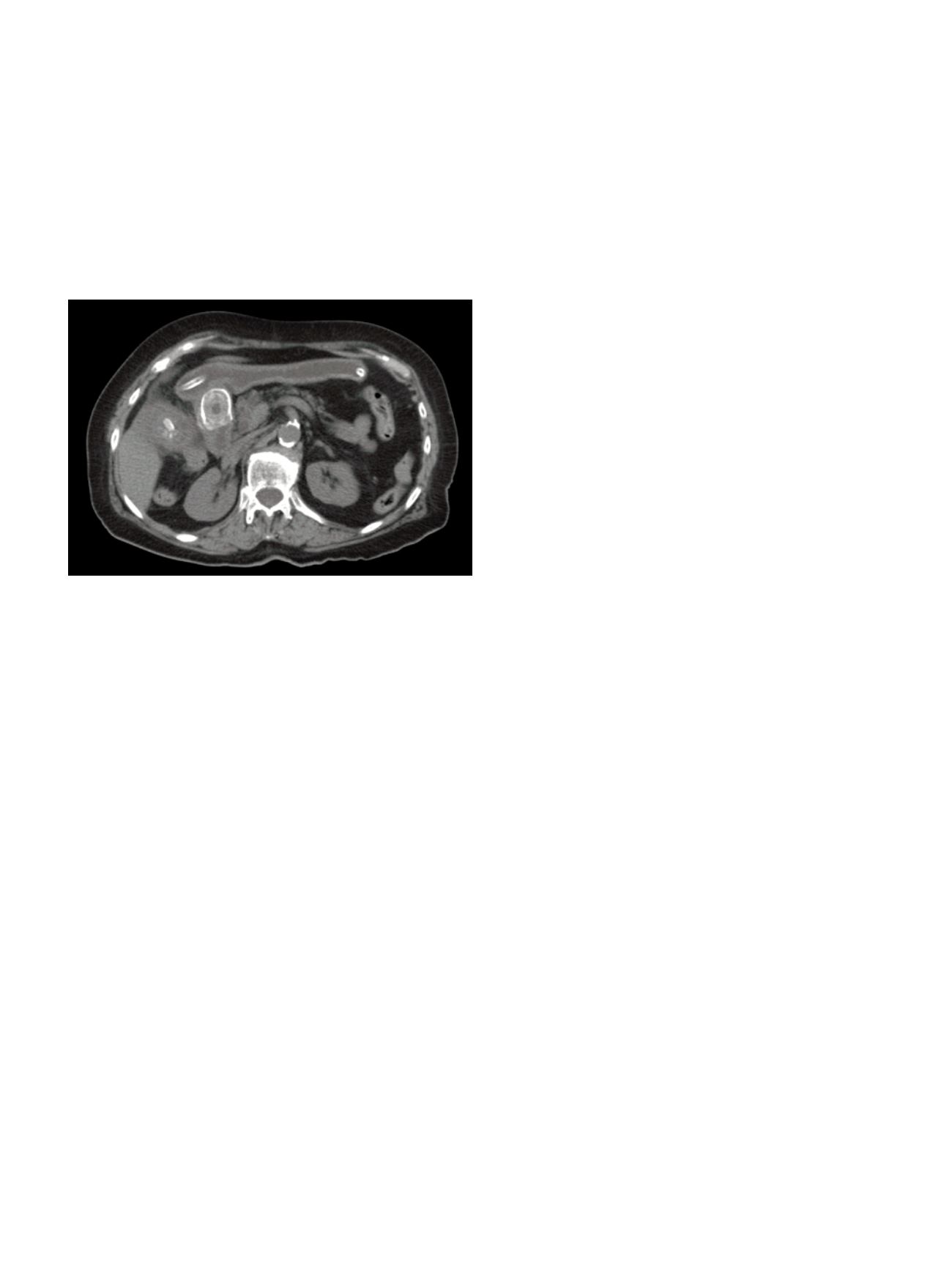
presence of a large obstructive stone in the duodenal bulb, unable to
be removed endoscopically even after pyloric dilation. To improve
the obstructive symptoms, the patient underwent gastro-jejunal
anastomosis with partial relief of the obstruction. In order to
fragment the stone, we performed another endoscopic procedure. A
laser Holmium YAG 30 W (HLS30W, Olympus GmbH) treatment was
applied for a total of about 200 minutes which resulted in stone’s
fragmentation into small parts removed by extraction basket and
retrieval device.
Results:
The patient was discharged 15 days after with a complete
resolution of the occlusive symptoms. The cholecystectomy was
cancelled.
Conclusions:
Holmium laser lithotripsy is safe and effective in the
treatment of a large impacted gallstone in the duodenum.
V.02.9
AN INDETERMINATE BILIARY STRICTURES ASSESSED USING THE
NEXT GENERATION SPYGLASS DS SYSTEM: A VIDEO CASE
Murino A.*, Pedroni N., Pisanu R., Pinna R., Sanna P., Zaru S., Cugia L.
Ospedale Civile SS Annunziata, Sassari, Italy
Background and aim:
Cholangiocarcinoma typically presents as
biliary strictures; an accurate diagnosis is fundamental to address
the best management. Although intraductal brushing during ERCP
is the designated method for tissue sampling of biliary strictures, its
sensitivity is low varying between of 27% to 56%. Spyglass system also
known as Peroral cholangioscopy (POC) permits direct visualization
and biopsies of the biliary tree for diagnostic procedures. The aim of
this video case was to show the usefulness of the next generation of
Spyglass system for the characterization of a indeterminate biliary
stricture.
Material and methods:
A 70 years old male with a suspected
lesion located in the head of the pancreas, identified at CT scan and
associated with a biliary stricture underwent EUS and ERCP. At that
time brush cytology and fine needle aspiration (FNA) were performed
and a plastic biliary stent was successfully placed. Despite the
improvement of the patient symptoms, a certain diagnosis was not
made due to inconclusive results of brush cytology and FNA. After
a few months, following the worsening of the patient conditions, a
next generation of Spyglass system was performed during the ERCP
in order to charachterise the indeterminate biliary stricture.
Results:
During the ERCP a clogged plastic biliary stent (Olympus
double layer, 6cm 10 Fr) was identified in placed and removed using
a polypectomy snare. Once the cholangiography was performed, a
stricture located in the distal common bile duct was identified and
dilated using a 12mm balloon dilatation. A SpyGlass assessment of
the biliary tract was then successfully performed and an endophyting
irregular and ulcerated lesion was located in the distal common
bile duct. Multiple targeted biopsies were then taken through the
spyglass biopsies channel using a dedicated biopsies forceps. A 6
cm uncovered metallic stent was then placed. The histopathological
analysis confirmed a pancreatic neoplasia involving the biliary duct.
Conclusions:
The next generation SpyGlass system appeared to be
an useful and safe technique that allows the characterization of an
indeterminate biliary stricture and it can be easily performed by
one operator. In addition, the improvement of the images quality,
compare to the previous generation of SpyGlass system, allows an
accurate inspection of the biliary tract.
V.02.10
AN INNOVATIVE EVALUATION OF PANCREATIC CYSTS BY
CONFOCAL LASER ENDOMICROSCOPY AND FIBER OPTIC
LIGHTING DIRECT VISUALIZATION SYSTEM
Gaia S.*, Bruno M., Ribaldone D.G., Fasulo R., Marietti M.,
De Angelis C.
AUO Città della Salute e della Scienza, Gastroenterology and
Endoscopy Unit, University of Turin, Turin, Italy
Background and aim:
Pancreatic cysts are a frequent diagnostic
challenge. Endoscopic ultrasound (EUS) with Fine Needle Aspiration
is often used for differential diagnosis, but both cytology and cystic
fluid analysis are often inconclusive.
Material and methods:
We report a video showing the exploration
of two different pancreatic cysts with both confocal laser
endomicroscopy (CLE) probeby Cellvizio (AQ flex probe; Mauna Kea
Technologies) and direct visualization by SpyGlass System (Boston
Scientific).
Case A: a 75-year-old woman presented with an incidentally
discovered, 4 cm cyst of the pancreatic body identified on CT scan.
Case B: a 45-year-old woman presented with a slightly growing 6
cm cyst of the pancreatic tail and two previous episodes of acute
pancreatitis. On EUS exploration contrast enhanced thin peripheral
septa were detected.
The cysts were punctured with a 19 gauge Expect Flexible Needle
(Boston Scientific) in which the CLE probe and SpyGlass optic fiber
were introduced.
Results:
Macroscopic and microscopic images of the pancreatic
wall are provided in the VIDEO and the utility of CLE and Spyglass
is discussed comparing the diagnostic yield of these innovative
procedures with cyst cytology and CEA/amylase levels in the cystic
fluid.
Conclusions:
New promising devices are available to obtain a
definite diagnosis of pancreatic cysts by direct endoscopic and
microscopic exploration.
V.02.11
EUS GUIDED CISTO-GASTRIC DRAINAGE AFTER EUS-GUIDED
GASTRO-GASTRIC ANASTOMOSIS TO TREAT A SIMPTOMATIC
PANCREATIC PSEUDOCYST IN PATIENT WITH ROUX–EN-Y
GASTRIC BY-PASS: THE DREAM BECAMES REALITY!
Sica M.*, Manta R., Tringali A., Mutignani M.
Surgical Digestive Diagnostic and Interventional Endoscopy, “Niguarda
Ca’ Granda Hospital”, Milano, Italy
Background and aim:
From 10% to 15% of acute pancreatitis is
complicated by pancreatic pseudocysts, which show spontaneous
resolution in 50% of the cases. Treatment is indicated in symptomatic
or complicated persistent pseudocysts. Drainage of pancreatic
pseudocysts using endoscopic techniques is the current preferred
method.